Betula papyrifera: Betula is Latin for birch;
papyrifera from the Greek word 'papurus,' meaning 'papyrus' or 'paper' and the Latin word 'fero' meaning 'to bear, carry, bring'. Taken together,
papyrifera means "paper bearing," for the tree's paper-like bark.
Native American tribes often used this tree to make canoes due to its waterproof bark. The bark can also be used to create a durable, waterproof layer in constructing sod-roofed houses.
 Native to the north east United States and Canada. Branches are only slightly more upright than B. pendula. This species will naturally hybridize with almost any other native birch.
  Leaves alternate, 1-3" long with doubly serrate margins. Often unequally cordate at the base. Upper surface glabrous, minutely hairy underneath. Fall color is yellow.
  Pendulous male catkins 4" long in clusters of 1-3 in late winter to early spring. Female fruiting catkins (not pictured) 1" long occur at the ends of branches. Trees are monoecious.
 Smooth, thin white bark with horizontal orange lenticels peels off in large papery sections. Young twigs are a shiny orange-brown. Compare to B. pendula whose bark cracks with maturity, revealing dark brown to black bark underneath.
  White trunks create a striking winter silhouette.
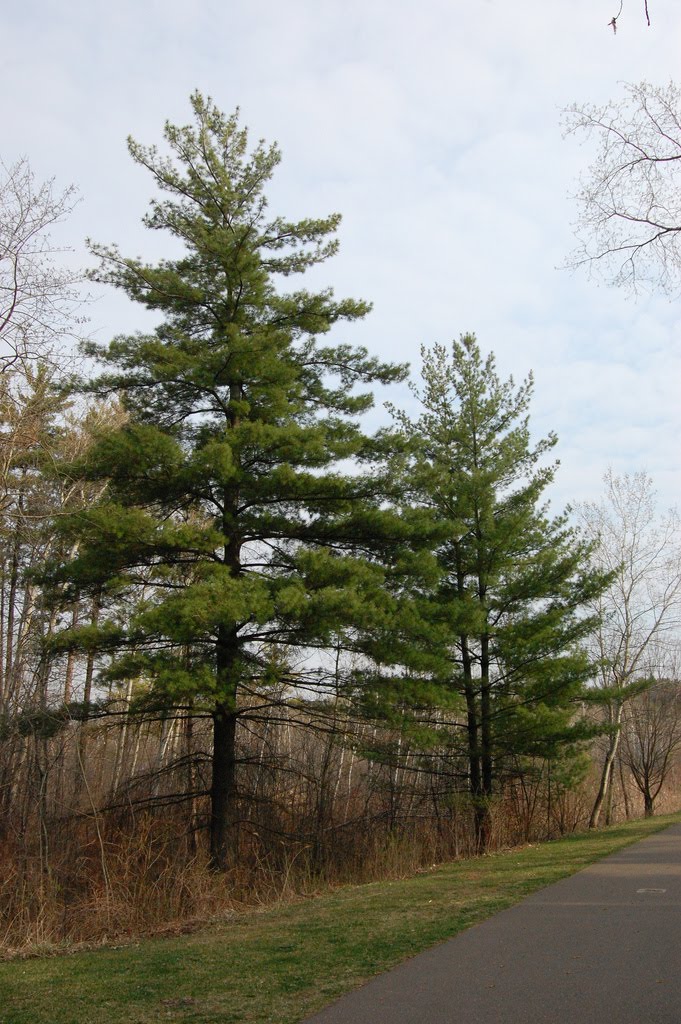
 Needles are soft, bluish green, 3-5" long, 5-fascicled, twisted, with minute teeth on all sides, whorled completely around branchlets, persisting 3-4 years.
  Cones are reddish brown, 3-8" long, slender, long-stalked, with light-tipped scale ends and no spines.
  Bark is thin, smooth and light gray, thickening and darkening to grayish brown with rectangular scaly plates.


