Showing posts with label Deciduous. Show all posts

Sunday, March 13, 2011

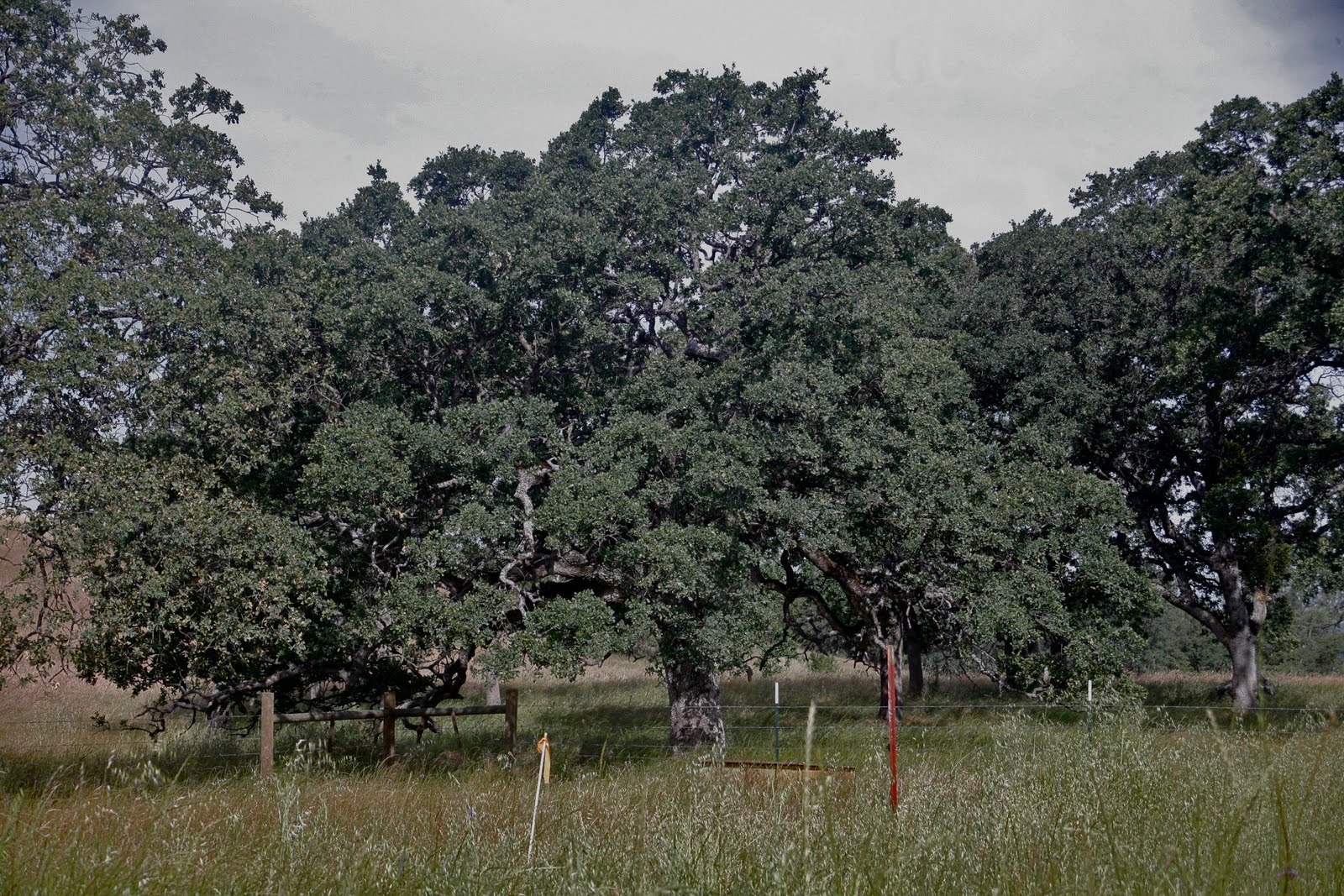
Quercus douglasii - Blue Oak

Quercus douglasii: Quercus the classical Latin name for the oak; douglasii, named for David Douglas (1798-1834), a Scottish collector from the Horticultural Society of London looking for North American plants that could grow in English gardens.

Native to California's Central Valley and foothills. Slow growth to 30-50' tall or more with a 40-70' spread, developing a broad, low-branching, rounded canopy, either leaning or slightly bent, and a heavy clear trunk.


Leaves are alternate, simple 1 - 1 1/2" long by 1/2 - 3/4" wide, dull bluish green, variable from broad oval to almost squarish, with scalloped edges, blunt, often bristle-tipped ends , sparsely covered with minute star-shaped hairs, often with harmless red gall-like warts on the uppersides, lighter undersides with very fine tiny soft hairs at midveins and branches and pastel pinkish orange or dull yellow fall color. Leaves are smaller and bluer than Q. lobata, which grows alongside.


Yellowish-green tassel-like flowers occur in early spring.


Acorns are deep brown, conical, 1/2 - 1 5/8" long by 3/8 - 3/4" wide, with a rounded, short-tipped end, a thin scaled cup covering 1/8 - 1/4 of the base of the nut, from a short-stalked base, maturing in fall of the first season, and occurring in profusion on healthy trees.


Brittle young twigs are dull gray to reddish brown with a slight minute hairiness. Bark is rather thin, light ashy gray with narrow ridges, peeling off easily in thin flakes.


A highly desirable native oak that tolerates valley and foothill heat and seasonal drought. Longevity estimated to be 200-300 years.

Monday, June 7, 2010

Crataegus laevigata - English Hawthorn

Crataegus laevigata: Crataegus is the Greek name for this genus of trees. Derives from kratos meaning strength, referring to hardness of wood; laevigatais Latin meaning 'having a smooth or slippery surface.'

Previously known as C. oxyacantha from the Greek ‘oxus’ meaning sharp and ‘akantha’ meaning thorn.

Small stature tree from Europe. Greeks and Romans associated Hawthorne with marriage and fertility.

The straight species has white hermaphroditic flowers with a single whorl of petals in terminal corymbs. Flowers appear in spring and attract bees.

Cultivars with pink to red double and single flowers are common.

Clusters of small red, fleshy, pome fruits contain 1-5 seeds and are persistent through winter, attracting birds. Fruit is larger and purer red than C. phaenopyrum. Hawthorne Berries have been used since the nineteenth century to support the heart and to normalize cardiovascular functions.

Linnaeus' original description of C. oxyacantha was later disambiguated into C. monogyna (left) and C. laevigata (right), the main difference being the depth of the sinuses between lobes. C. laevigata also has rounder lobes and serrate margins, whereas C. monogyna can have entire margins or points just at the tips of lobes.

Branches have sharp 1" spines. The branches of this tree are said to have furnished Christ's crown of thorns.

Bark is reddish brown to gray and becomes scaly or peels in thin narrow strips with age.

Sunday, June 6, 2010

Betula papyrifera - Canoe Birch or Paper Birch

Betula papyrifera: Betula is Latin for birch; papyrifera from the Greek word 'papurus,' meaning 'papyrus' or 'paper' and the Latin word 'fero' meaning 'to bear, carry, bring'. Taken together, papyrifera means "paper bearing," for the tree's paper-like bark.

Native American tribes often used this tree to make canoes due to its waterproof bark. The bark can also be used to create a durable, waterproof layer in constructing sod-roofed houses.

Native to the north east United States and Canada. Branches are only slightly more upright than B. pendula. This species will naturally hybridize with almost any other native birch.

Leaves alternate, 1-3" long with doubly serrate margins. Often unequally cordate at the base. Upper surface glabrous, minutely hairy underneath. Fall color is yellow.

Pendulous male catkins 4" long in clusters of 1-3 in late winter to early spring. Female fruiting catkins (not pictured) 1" long occur at the ends of branches. Trees are monoecious.

Smooth, thin white bark with horizontal orange lenticels peels off in large papery sections. Young twigs are a shiny orange-brown. Compare to B. pendula whose bark cracks with maturity, revealing dark brown to black bark underneath.

White trunks create a striking winter silhouette.
Friday, June 4, 2010

Acer saccharinum - Silver Maple

Acer saccharinum: Acer is the Latin name for maples; saccharinum refers to the tree's sweet sap. This species yields about half the amount of sugar as A. saccharum.

Native to wet floodplain forests in the Eastern United States.

Deeply 5-lobed leaves with sharply serrate margins are dark green on top, but silvery grey underneath, giving the tree its common name.

Yellow to orange to red fall color, often seen all together.

Tiny corymbs of red polygamous, apetalous flowers in late winter (~March) before the tree leafs out.

Samaras with twin seeds are joined at almost 180ยบ. Fruit matures in late spring and persists through the summer.

Bark is light silver-grey, turning darker grey with maturity with narrow fissures and scaly plates.

Monday, May 17, 2010

Sophora japonica - Japanese Pagoda Tree

also known as Chinese Scholar Tree


Seed pods (legumes) resemble a string of pearls.

Sunday, May 16, 2010

Robinia x ambigua 'Purple Robe' - Purple Robe Locust

Patented hybrid between Robinia ambigua 'Decaisneana' and R. hispida 'Monument.'


Pinnately compound leaves with ovate to oblong leaflets. Mostly thornless, but there are rounded thorn nubs at leaf nodes.

Purple flowers are mostly scentless, but a deep whiff with your nose buried in the blossoms can yield a faint rose scent.

Reddish brown to gray bark develops fissures and cracks. Wood is brittle and limbs tend to break on older trees.

Melia azedarach - China-Berry


Saturday, May 15, 2010

Gleditsia triacanthos inermis - Thornless Honey Locust

Cultivar 'Sunburst' has yellow foliage.

Leaves pinnately or bipinnately compound.


Friday, May 14, 2010

Crataegus phaenopyrum - Washington Thorn


Watch out for long thorns.

Celtis sinensis - Chinese Hackberry

Medium textured tree with leathery leaves.

Distal 1/3 of leaf margins are crenate to serrate with entire margins about the leaf base. Leaf base is oblique, as is typical of the Elm family (Ulmaceae).

Smooth grayish brown bark takes on blackish margins and warty growths with age, often with shallow furrows and ridges.