Showing posts with label California. Show all posts

Wednesday, June 22, 2011

Pinus contorta ssp. bolanderi - Bolander Pine

Pinus contorta ssp. bolanderi: Pinus is the Latin name for P. pinea; contorta or 'twisted,' referring to the species' twisted needles; bolanderi, named after Henry Nicholas Bolander (1831-1897), a collector of plants in Yosemite National Park and California State Botanist in 1864.

This subspecies is endemic to the Pygmy Forest in Mendocino Co., California where there are coastal terrace soils with claypan or hardpan. It is closely related to P. contorta contorta and P. contorta murrayana.

Bolander pine often grows in thickets of cane-like trees that, although very small, are biologically mature and bear fertile cones.


Needles 1.25-2" long, 2 per fascicle, often twisted.


Reddish immature cones.


Asymmetric seed cones ~3 inches long remain closed on the stem for many years.


Scaly grey bark.

Sunday, March 13, 2011

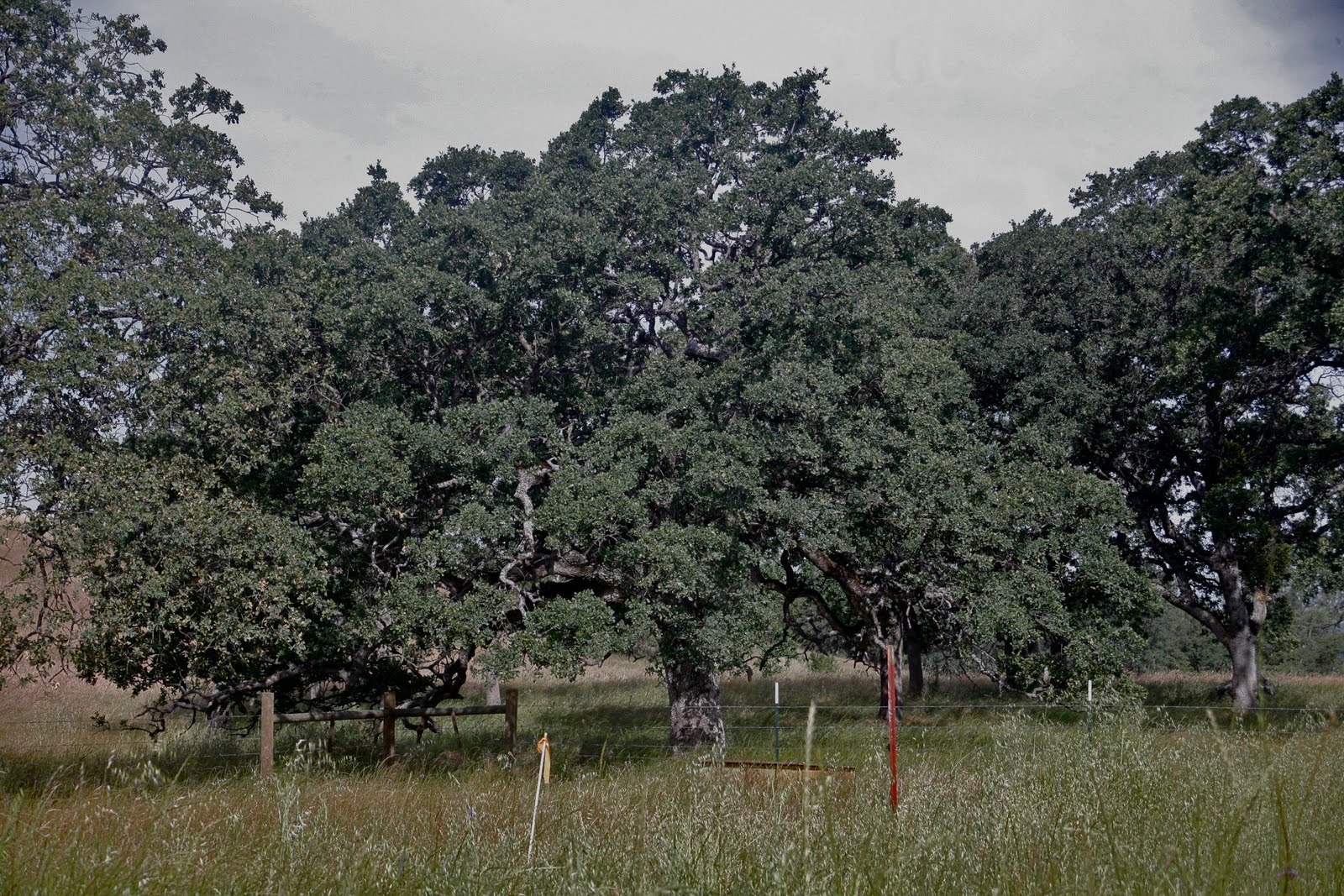
Quercus douglasii - Blue Oak

Quercus douglasii: Quercus the classical Latin name for the oak; douglasii, named for David Douglas (1798-1834), a Scottish collector from the Horticultural Society of London looking for North American plants that could grow in English gardens.

Native to California's Central Valley and foothills. Slow growth to 30-50' tall or more with a 40-70' spread, developing a broad, low-branching, rounded canopy, either leaning or slightly bent, and a heavy clear trunk.


Leaves are alternate, simple 1 - 1 1/2" long by 1/2 - 3/4" wide, dull bluish green, variable from broad oval to almost squarish, with scalloped edges, blunt, often bristle-tipped ends , sparsely covered with minute star-shaped hairs, often with harmless red gall-like warts on the uppersides, lighter undersides with very fine tiny soft hairs at midveins and branches and pastel pinkish orange or dull yellow fall color. Leaves are smaller and bluer than Q. lobata, which grows alongside.


Yellowish-green tassel-like flowers occur in early spring.


Acorns are deep brown, conical, 1/2 - 1 5/8" long by 3/8 - 3/4" wide, with a rounded, short-tipped end, a thin scaled cup covering 1/8 - 1/4 of the base of the nut, from a short-stalked base, maturing in fall of the first season, and occurring in profusion on healthy trees.


Brittle young twigs are dull gray to reddish brown with a slight minute hairiness. Bark is rather thin, light ashy gray with narrow ridges, peeling off easily in thin flakes.


A highly desirable native oak that tolerates valley and foothill heat and seasonal drought. Longevity estimated to be 200-300 years.

Thursday, March 10, 2011

Torreya californica - California Nutmeg

Torreya californica: Torreya named after John Torrey (1796-1873), a professor of chemistry and one of the giants of North American botany; californica from California, where it grows natively.

Also known as Stinking Cedar.

Growth rate slow to 15-20' tall (taller in native habitat) with a 12-15' spread and a trunk 1-3' in diameter. Often multitrunked with an open, broad pyramidal crown, rounded in age, rangy in forest locations, with slender horizontal branches standing out straight from the trunk in symmetrical circles, drooping at the ends.


Needlelike leaves are rigid, flat, linear-lanceolate, 1 1/4" to 2" long, shiny deep green and spirally arranged and appearing flatly 2-ranked, with sharp pointed edge and two whitish bands on the underside of the leaf. Crushed leaves have a strong scent. Current year's shoots are green but turn reddish brown by the third year.


Fruits are 1-2" long, ovoid, plumlike, pale green, with purple streaks, a blunt pointed end, and wrinkled skin when matured in the fall of the second season. Seeds have a thin hard brittle shell and germinate after 2 years.


Bark is ashy yellowish brown, finely checkered with narrow seams and short, narrow, loose, scaly ridges.


California nutmeg is found on moist, rocky sites within the shade of tall, coniferous forests 2,000' - 7,000'. It grows as a shrub on serpentine soils.

Monday, March 7, 2011

Chamaecyparis nootkatensis - Alaska Yellow Cedar

Chamaecyparis nootkatensis: Chamaecyparis Chamaecyparis from the Greek chamae, "dwarf, low-growing, or growing on the ground" and kyparissos, "cypress," meaning "dwarf or ground cypress;" nootkatensis of or from the area of Nootka Sound or Nootka Island in Alaska.

Synonyms: Cupressus nootkatensis, Callitropsis nootkatensis, Xanthocyparis nootkatensis. Also known as Nootka Cypress.

Growth rate slow to 80' tall, though often dwarfed at high elevations, and a 25' spread at the base, developing an open, dense, narrowly conical form.


Weeping, flat sprays of blue-green to yellowish foliage have scale-like leaves with sharp, spreading tips.


Cones are similar to C. lawsoniana with wide, flat scales opening to expose the center, but only have four to six scales. Small reddish or brown male flowers appear as swollen bulbs at leave tips, shedding pollen in spring. Tiny green female flowers form small, 1/4" long, round, deep cones with a whitish cast, ripening in fall.


Bark is thin, brown, becoming gray with age, irregularly ad finely broken by shallow seams, with wide, flat scaly ridges, frequent diagonal crossings, peeling in narrow, flat, vertical strips.


Native to the coastal mountains from southeast Alaska to southwestern Oregon, with a few small groves in California's Siskiyou Mountains making up the southern extent of its range. Alaska Yellow Cedars generally grow on north-facing slopes from 4,500 - 6,900' elevation and most often consist of populations of scattered shrubs of this cedar. Longevity estimated to be 200-275 years on average. Canada's oldest known tree is an Alaska Yellow Cedar with 1,636 annual rings. It is said to have perished on Vancouver Island in the early 1990s.

Saturday, March 5, 2011

Pinus lambertiana - Sugar Pine

Pinus lambertiana: Pinus is the Latin name for pine; lambertiana, named for the British botanist Aylmer Bourke Lambert, who is best known for his work A description of the genus Pinus.

Native to the Sierra Nevada and southern Cascade Ranges at 3,000-5,000' elevation. Occurs naturally among other pines, firs and incense cedars, which usually predominate. Not readily adaptable to cultivation.

Growth rate initially slow, faster with age to 200' tall or more with a 50' spread, pyramidal in youth with slender horizontal branching and distinctively loose foliage. Older trees often developing a sizable trunk with broad sweeping limbs giving a somewhat tiered effect and long cones hanging like ornaments from branch tips. One of the tallest pines.


Needles are dark bluish green, 2 to 3 1/2" long, 5-fascicled, with a whitish tinge, persisting 2-3 years, tufted at ends of slender branchlets.


Cones are the largest of all pines at 10-20" long (!), cylindrical, 3-4" in diameter, light brown, with shiny tipped scales with a darker inner surface and sometimes a glop of pitchy sap, ripening in late sumer of the second year and shedding dark brown to blackish 1/2" flattened seeds with a 3/4-1" long rounded wing in fall.


P. lambertiana has thicker cone scales, more horizontal cone scales compared P. monticola's thinner, descending scales with a light colored tip that contrasts with the darker inner cone scale.


Bark is thin, smooth, and grayish becoming grayish brown, deeply furrowed with long irregular plates along the ridges.

Monday, February 14, 2011

Chamaecyparis lawsoniana - Port Orford Cedar

Chamaecyparis lawsoniana: Chamaecyparis from the Greek chamae, "dwarf, low-growing, or growing on the ground" and kyparissos, "cypress," meaning "dwarf or ground cypress;" lawsoniana named after Charles Lawson (1794-1873), since 1821 the head of Peter Lawson and Son Nursery in Edinburgh, Scotland, a nursery founded in 1770 by his father Peter Lawson. The Lawson cypress was first discovered near Port Orford in Oregon and introduced into cultivation in 1854 by collectors working for the Lawson and Son nursery who sent seeds back to Scotland.

Also known as Lawson's Cypress.

Evergreen native to coastal Oregon and the California coastal ranges. Moderate growth rate to 60' in cultivation, 200' in habitat with 30+' spread, developing a dense pyramidal or columnar shape with branching often to the ground.


Lacy, drooping, flat foliage sprays are variable blue-green with minute flattish scalelike leaves, soft to the touch with short blunt points.


Insignificant reddish or brown male flowers appear a swollen bulbs at leaf tips an dshed pollen in spring. Tiny green female flowers form berrylike, reddish brown, 3/8" long, oval cones among the foliage, maturing in fall of the first season, when the 8 wide flat scales open exposing the center portion when ripe.


Bark is thin, brown, becoming gray with age, with irregular shallow seams and flat, shallow ridges , frequent diagonal crossings, peeling in narrow, flat, vertical strips.


Resinous substance in wood is toxic to termites, making this a valuable timber tree. Originally used for uses as diverse as shipbuilding and match sticks, it is now the most valuable wood harvested in western North America, thanks to past overexploitation. Longevity estimated at 200 years in cultivation and up to 600 years in habitat.

Saturday, February 12, 2011

Cupressus macrocarpa - Monterrey Cypress

Cupressus macrocarpa: Cupressus is the Latin name for the Italian Cypressus tree (Cupressus sempervirens); macrocarpa, referring to the species' large cones.

Evergreen cypress native only to the Monterrey peninsula along the California coast, but extensively naturalized in California and around the globe. Famous for its silhouette and cultivated in coastal areas as a dense, fast-growing windbreak, hedge or park tree. Needs a moist, cool climate. Longevity 100 years in cultivation, up to 200 years in habitat.

Moderate to fast growth to 60' tall x 35' wide, with a dense, pyramidal form in youth, broad at the base with strong horizontal branching angled upward to a pointed crown. Lower branches eventually die back on older trees, giving a wider, flat-topped crown.


Foliage is dark or bright green and scale-like, each scale ~1/16" long, with blunt tips, usually without glands.


Male flowers appear as yellowish buds at the ends of foliage and shed pollen in March.


Greenish females form dark brown to grayish 1" round cones, with 4-6 wide, flat scales with blunt knots maturing in August fo the second year, openaing at seams between scales. Cones remain attached to the tree for several years.


Bark is reddish brown, narrowly seamed with a network of narrow vertical ridges and smaller diagonal ones, often taking a grayish cast as it weathers.

Monday, January 31, 2011

Picea sitchensis - Sitka Spruce

Picea sitchensis: Picea rom the Latin 'pix' for 'pitch,' referring to the spruce's resin, which was used in the manufacture of pitch before the use of petrochemicals; sitchensis, named for Sitka, Alaska, where this tree grows native.

Evergreen. Native to coastal mountains from sea level to 3,000' elevation from British Columbia to northern California. Tallest of the spruces, and a valuable forest tree in the northwest. Grows in loose, acidic soils with high rainfall in temperate coastal areas. Tolerates wet soils and salt spray.

Grows to 160+' with a 40' spread, developing a tall, open, conical crown, a broad base, upswept branches, and a narrow to tapered top, more bushy and less upright near windswept coastlines.


View from below.


1"needles are stiff, bristly, bright green with bluish to grayish green new growth, with prickly ends, somewhat flattened and indistinctly 4-angled, standing straight out evenly and completely around branchlets.


Pendulous cones are light brown, oblong-elliptical, 2-4" long, with thin, toothed, somewhat undulating, papery scales, maturing in one season and falling in winter.


Open, mature cone.


Bark is thin, scaly, gray-brown on younger trees, becoming deep reddish brown with large, flat easily detached scales. Wood is highly valued for strength and is used in making violins for its resonant qualities.

Tuesday, October 12, 2010

Tsuga heterophylla - Western Hemlock

Tsuga heterophylla: Tsuga is from a Japanese name for their native hemlocks; heterophylla, meaning 'different leaves' referring to the short and longer needles that grow together along a branchlet.

Tall, straight tree with a drooping leader and branch tips. Growth rate slow to moderate up to 150+' in its native habitat by 20-30' wide, developing a tall, pyramidal form. Often rather spindly and shapeless in its densely shaded forest habitat, becoming more shapely in sunnier locations.


Needles are glossy, yellow-green, 1/2" long, appearing to grow from opposite sides of branchlets. appearing 2-ranked, or in a flattened profile, from a short stem, with grooved uppersides, persisting 3-4 years.


Cones are light brown, elliptical, 1" long with thin papery scales, hanging along ends of branchlets, maturing in summer of the first season.


Bark is thin, brown, finely scaled, becoming thicker and harder, dark brown and red-tinged, deeply furrowed, with flat, wide ridges irregularly interconnected with narrow cross-ridges.


Evergreen. Native to the Pacific Coast from Alaska to northern California at 2,000-5,000' elevation. Western hemlock is mainly a tree of temperate rainforests, but it also occurs in the northern Rockies. On the coast it may experience 150" of rain (in Alaska), or less than 40" (Eureka, California). Inland it is confined to shady, north-facing slopes and stream bottoms. It tolerates a wide variety of soils and ranges from sea level to 2,000 feet. Grows mostly among Sequoia sempervirens, Picea sitchensis and Thuja plicata.

Monday, October 11, 2010

Thuja plicata - Western Redcedar

Thuja plicata: Thuja from the Greek name 'thuia' or 'thyia,' a kind of juniper or other resinous tree; plicata, meaning 'pleated'.

Also known as Canoe Cedar, in reference to the canoes made from its rot-resistant wood by Native American tribes in the Pacific Northwest.

Pyramidal form with straight, tapered trunk with a buttressed trunk. Upper limbs are often horizontal; lower limbs droop to the ground, but most have upturned tips. Foliage is lighter green than that of associated conifers. Moderate growth rate up to 200' in its native habitat and 20-60' wide.


Flat, hanging, lacelike, green foliage sprays of small, decussate, scale-like leaves. Delightfully aromatic when crushed.


Sprays of foliage from shady (left) and sunny (right) parts of the same tree.


Cones are 1/2" round, reddish brown, with 6 fertile scales, maturing and releasing 2-3 seeds each in late summer o the first year.


Bark is thin, reddish brown, fibrous, with shallow furrows and long vertical ridges, peeling in long strips and taking on a grayish cast with age. Trunk base is often fluted.


Evergreen. Native to the northwestern U.S. from coastal California to Alaska east to Montana. Western redcedar grows under temperate rainforest conditions alongside Sequoia sempervirens, Picea sitchensis, Tsuga heterophylla and Pseudotsuga menziesii. Summers are relatively cool, winters are mild, rainfall is heavy and supplemented by ample fog-drip. It is sometimes found in boggy soil.

Friday, October 8, 2010

Abies bracteata - Santa Lucia Fir

Abies bracteata: Abies is the Latin name for silver fir; bracteata refers to the species' extraordinarily long cone scale bracts.

Also known as the Bristlecone Fir.

Narrowly conical, steeple-like crown, with short, slightly drooping branches near the top and wide-spreading branches at the base, often to the ground. Growth rate moderate, slower with age, to 70' tall (to 100' in habitat) and 15-20' wide.


Needles are stiff, flat, shiny dark green 2" long, twisted near the base, with sharply pointed tips and 2 whitish stripes on the undersides, sometimes occurring in flattened sprays on lower branches. Compare to Torreya californica. Twigs are glabrous, with long, narrow, sharply pointed, 1" long non-resinous buds.


Purplish brown cones are upright 3" long, with thin, broadly rounded, tightly clasped scales, each bract extendign into a 1/2 to 1-3/4" long yellowish brown, hairlike bristle, curving outward around the cone.


Cones are rarely seen, disintegrating when fully mature and releasing ovoid, reddish brown broad-winged seeds. Pictured above are cone scales with bracts and a spike to which cone scales were formerly attached.


Bark is smooth, thin, grayish brown, thickening and becoming scaly and slightly fissured, often with pitch oozing from cracks in the bark.


Evergreen. Native to the Santa Lucia mountains of Monterrey and San Luis Obispo counties of California. The Santa Lucia Fir occupies steep, rocky slopes above the cool, windswept, foggy coast, usually between 2,000 and 5,000 feet in mixed-evergreen forests at sites with annual rainfall in excess of 100 inches.